 Journalists with access to leaked documents have reported on the partnerships and activities undertaken by Canada’s foreign signals intelligence (SIGINT) agency, the Communications Security Establishment (CSE), since October 2013. As a result of their stories we know that the Canadian government hosts collection facilities in its diplomatic outposts for American SIGINT operations, has co-ordinated with the NSA to monitor for threats to international summits that took place in Canada, and shares a cooperative relationship with the National Security Agency (NSA) to protect North America from foreign threats. CSE, itself, was found to be conducting signals intelligence and development operations against the Brazilian government, running experiments using domestically collected metadata to track Canadians’ devices, and automating both the discovery of vulnerable computer devices on the Internet for later exploitation and identifying network administrators’ Internet traffic.
The aforementioned revelations are just a sample of what Canadians have learned as journalists have reported on documents leaked to them by Edward Snowden and other whistleblowers. But it has been challenging for even experts to keep track of the Canadian discoveries amongst the tidal wave of information concerning American and British SIGINT agencies. I have created and published a resource to help researchers and members of the public alike track mentions of CSE in documents that have been reported on by professional journalists.
The Canadian SIGINT Summaries page of this website currently includes downloadable copies, along with summary, publication, and original source information, of leaked CSE documents. The page will be updated as new whistleblower documents are released and as I parse and add information about CSE’s operational guides that have been released to the public under Access to Information and Privacy (ATIP) laws. I plan to also include copies of the CSE Commissioner’s reports. While I will try to exhaustively collate documents it is entirely possible that I have, or will, miss some; if you believe I have failed to include a primary document and would like me to add it to the SIGINT Summaries page please contact me with the document and a link to the journalistic source which reported on it.
The Canadian SIGINT Summaries are not meant to replace the detailed reporting of documents nor the exhaustive examination of them by other researchers, scholars, or other analysts. And I expect to write more extensive analyses based upon the documents that extend beyond my summarizations of them. The Canadian SIGINT Summaries are meant as a public resource, listing all of the relevant public documents, briefly describing their contents and publication data, and letting readers download them to draw their own conclusions.
As I update the page with new items or sections I will publish blog posts which either include the item (if just one or two are added) or short summaries when larger updates are published. I hope that you find the Canadian SIGINT Summaries helpful and, for international visitors, encourage you to replicate this model to summarize information about your own domestic SIGINT agency.
 In our recent report, “The Governance of Telecommunications Surveillance: How Opaque and Unaccountable Practices and Policies Threaten Canadians,” we discussed how the Communications Security Establishment (CSE) developed and deployed a sensor network within domestic and foreign telecommunications networks. While our report highlighted some of the concerns linked to this EONBLUE sensor network, including the dangers of secretly extending government surveillance capacity without any public debate about the extensions, as well as how EONBLUE or other CSE programs programs collect information about Canadians’ communications, we did not engage in a comparison of how Canada and its closest allies monitor domestic network traffic. This post briefly describes the EONBLUE sensor program, what may be equivalent domestic programs in the United States, and the questions that emerge from contrasting what we know about the Canadian and American sensor networks.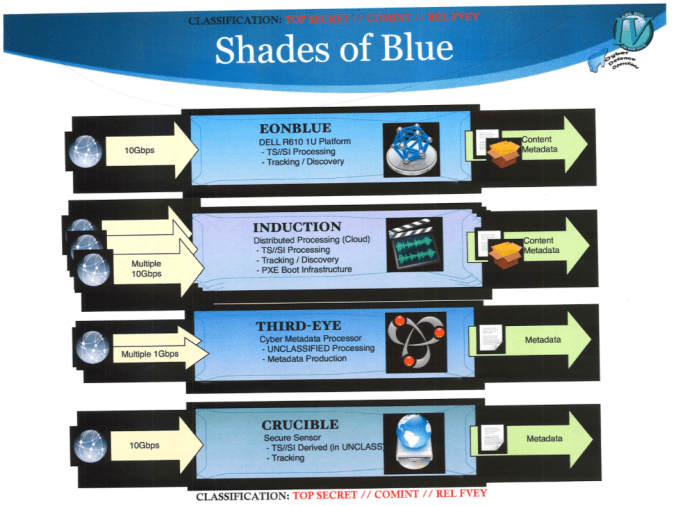
 I have added five new items to the SIGINT Summaries page. The Summaries include downloadable copies of leaked Communications Security Establishment(CSE) documents, along with summary, publication, and original source information.
 Technology, Thoughts & Trinkets