Why We Need to Reevaluate How We Share Intelligence Data With Allies

OLYMPUS DIGITAL CAMERA

Last week, Canadians learned that their foreign signals intelligence agency, the Communications Security Establishment (CSE), had improperly shared information with their American, Australian, British, and New Zealand counterparts (collectively referred to as the “Five Eyes”). The exposure was unintentional: Techniques that CSE had developed to de-identify metadata with Canadians’ personal information failed to keep Canadians anonymous when juxtaposed with allies’ re-identification capabilities. Canadians recognize the hazards of such exposures given that lax information-sharing protocols with US agencies which previously contributed to the mistaken rendition and subsequent torture of a Canadian citizen in 2002.

Tamir Israel (of CIPPIC) and I wrote and article for Just Security following these revelations. We focused on the organization’s efforts, and failure, to suppress Canadians’ identity information that is collected as part of CSE’s ongoing intelligence activities and the broader implications of erroneous information sharing. Specifically, we focus on how such sharing can have dire life consequences for those who are inappropriately targeted as a result by Western allies and how such sharing has led to the torture of a Canadian citizen. We conclude by arguing that the collection and sharing of such information raises questions regarding the ongoing viability of the agency’s old-fashioned mandates that bifurcate Canadian and non-Canadian persons’ data in light of the integrated nature of contemporary communications systems and data exchanges with foreign partners.

Read the Article

Authors

Tamir Israel

Tamir is staff lawyer with the Samuelson-Glushko Canadian Internet Policy & Public Interest Clinic (CIPPIC) at the University of Ottawa Faculty of Law, where he conducts research and advocacy on various digital rights-related topics, with a focus on online privacy and anonymity, net neutrality, intellectual property, intermediary liability, spam, e-commerce, and consumer protection generally.

Christopher Parsons

Dr. Christopher Parsons received his Bachelor’s and Master’s degrees from the University of Guelph, and his Ph.D from the University of Victoria. He is currently the Managing Director of the Telecom Transparency Project and a Postdoctoral Fellow at the Citizen Lab, in the Munk School of Global Affairs.

Photo credit: Spies by Kieran Lamb (CC BY-SA 2.0) https://flic.kr/p/416nVf
Stuck on the Agenda: Drawing Lessons from the Stagnation of “Lawful Access” Legislation in Canada

9780776622071_web_1Earlier this year I had a book chapter, titled “Stuck on the Agenda: Drawing Lessons from the Stagnation of “Lawful Access” Legislation in Canada” published in Law, Privacy and Surveillance in Canada in the Post-Snowden Era. The book was edited by Michael Geist and is freely available in .pdf format from the University of Ottawa Press. The edited collection brings together many of Canada’s leading thinkers on privacy and national security issues, with authors outlining how Canadian-driven intelligence operations function, the legal challenges facing Canadian signals intelligence operations, and ways to reform Canada’s ongoing signals intelligence operations and the laws authorizing those operations.

The book arguably represents the best, and most comprehensive, examination of the Communications Security Establishment (CSE) in recent history. While not providing insiders’ accounts, many of the chapters draw from access to information documents, documents provided to journalists by Edward Snowden, and publicly available information concerning how intelligence operations are conducted by Canadian authorities. In aggregate they critically investigate the actual and alleged intelligence practices undertaken by Canadian authorities.

My contribution focuses on the politics associated with Canada’s lawful access legislation, and identifies some of the political conditions that may precede successful opposition to legislation that expands or reifies both domestic and foreign intelligence surveillance practices. Specifically, the chapter begins by outlining how agenda-setting operates and the roles of different agendas, tactics, and framings. Next, it turns to the Canadian case and identifies key actors, actions, and stages of the lawful access debates. The agenda-setting literature lets us identify and explain why opponents of the Canadian legislation were so effective in hindering its passage and what the future holds for opposing similar legislative efforts in Canada. The final section steps away from the Canadian case to suggest that there are basic as well as additive general conditions that may precede successful political opposition to newly formulated or revealed government surveillance powers that focus on either domestic or signals intelligence operations. You can read the chapter on pages 256-283.

Download the book from University of Ottawa Press

Image credit: Book Cover from Michael Geist (Ed.) (CC BY-NC-SA 3.0) http://www.press.uottawa.ca/law-privacy-and-surveillance

Beyond Privacy: Articulating the Broader Harms of Pervasive Mass Surveillance

2852616711_57c5d04259_b

I’ve published a new paper titled “Beyond Privacy: Articulating the Broader Harms of Pervasive Mass Surveillance” in Media and Communication. Media and Communication is an open access journal; you can download the article from any location, to any computer, free of cost. The paper explores how dominant theories of privacy grapple with the pervasive mass surveillance activities undertaken by western signals intelligence activities, including those of the NSA, CSE, GCHQ, GCSB, and ASD. I ultimately argue that while these theories provide some recourse to individuals and communities, they are not sufficiently holistic to account for how mass surveillance affects the most basic elements a democracy. As such, I suggest that academic critics of signals intelligence activities can avail themselves to theory from the Frankfurt School to more expansively examine and critique contemporary signals intelligence surveillance practices.

Full Abstract

This article begins by recounting a series of mass surveillance practices conducted by members of the “Five Eyes” spying alliance. While boundary- and intersubjectivity-based theories of privacy register some of the harms linked to such practices I demonstrate how neither are holistically capable of registering these harms. Given these theories’ deficiencies I argue that critiques of signals intelligence surveillance practices can be better grounded on why the practices intrude on basic communicative rights, including those related to privacy. The crux of the argument is that pervasive mass surveillance erodes essential boundaries between public and private spheres by compromising populations’ abilities to freely communicate with one another and, in the process, erodes the integrity of democratic processes and institutions. Such erosions are captured as privacy violations but, ultimately, are more destructive to the fabric of society than are registered by theories of privacy alone. After demonstrating the value of adopting a communicative rights approach to critique signals intelligence surveillance I conclude by arguing that this approach also lets us clarify the international normative implications of such surveillance, that it provides a novel way of conceptualizing legal harm linked to the surveillance, and that it showcases the overall value of focusing on the implications of interfering with communications first, and as such interferences constituting privacy violations second. Ultimately, by adopting this Habermasian inspired mode of analysis we can develop more holistic ways of conceptualizing harms associated with signals intelligence practices than are provided by either boundary- or intersubjective-based theories of privacy.

Download the Paper

Photo credit: Retro Printers by Steven Mileham (CC BY-NC 2.0) https://flic.kr/p/5m5pyK

Canada’s Quiet History Of Weakening Communications Encryption

500995147_6c97aab488_o-300x225American and British officials have been warning with an increasing sense of purported urgency that their inability to decrypt communications could have serious consequences. American authorities have claimed that if they cannot demand decrypted communications from telecommunications providers then serious crimes may go unsolved. In the UK this danger is often accentuated by the threat of terrorism. In both nations, security and policing services warn that increased use of encryption is causing communications to ‘go dark’ and thus be inaccessible to policing and security services. These dire warnings of the threats potentially posed by criminals and terrorists ‘going dark’ have been matched over the years with proposals that would regulate encryption or mandate backdoors into any otherwise secure system. Comparatively little has been said about Canada’s long-standing efforts to inhibit end-user encryption despite the federal government’s longstanding efforts to restrict the security provided to Canadians by encryption.

This article outlines some of the federal government of Canada’s successful and unsuccessful attempts to weaken cryptographic standards. It starts by explaining (in brief) what communications encryption is, why it matters, and the implications of enabling unauthorized parties to decrypt communications. With this primer out of the way, we discuss why all of Canada’s mobile telecommunications carriers agree to implement cryptographic weaknesses in their service offerings. Next, we discuss the legislation that can be used to compel telecommunications service providers to disclose decryption keys to government authorities. We then briefly note how Canada’s premier cryptologic agency, the Communications Security Establishment (CSE), successfully compromised global encryption standards. We conclude the post by arguing that though Canadian officials have not been as publicly vocal about a perceived need to undermine cryptographic standards the government of Canada nevertheless has a history of successfully weakening encryption available to and used by Canadians.

Continue reading

‘Defending the Core’ of the Network: Canadian vs. American Approaches

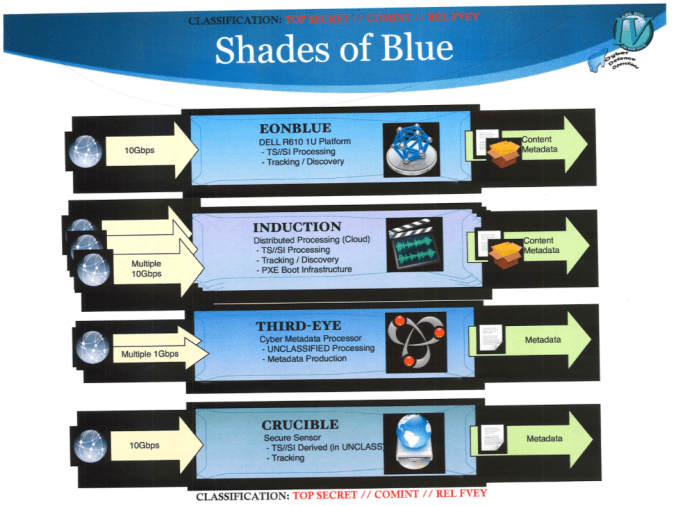
U.S. Cyber Command recently conducted on Fort Meade its first exercise in collaboration with cyber subject-matter experts from across the National Security Agency, National Guard, Department of Homeland Security and FBI.In our recent report, “The Governance of Telecommunications Surveillance: How Opaque and Unaccountable Practices and Policies Threaten Canadians,” we discussed how the Communications Security Establishment (CSE) developed and deployed a sensor network within domestic and foreign telecommunications networks. While our report highlighted some of the concerns linked to this EONBLUE sensor network, including the dangers of secretly extending government surveillance capacity without any public debate about the extensions, as well as how EONBLUE or other CSE programs programs collect information about Canadians’ communications, we did not engage in a comparison of how Canada and its closest allies monitor domestic network traffic. This post briefly describes the EONBLUE sensor program, what may be equivalent domestic programs in the United States, and the questions that emerge from contrasting what we know about the Canadian and American sensor networks.

What is EONBLUE?

EONBLUE was developed and deployed by the CSE. The CSE is Canada’s premier signals intelligence agency. The EONBLUE sensor network “is a passive SIGINT system that was used to collect ‘full-take’ data, as well as conduct signature and anomaly based detections on network traffic.” Prior Snowden documents showcased plans to integrate EONBLUE into government networks; the network has already been integrated into private companies’  networks. Figure one outlines the different ‘shades of blue’, or variations of the EONBLUE sensors:

EONBLUE Sensors

Continue reading

The Governance of Telecommunications Surveillance

Last week I released a new report, The Governance of Telecommunications Surveillance: How Opaque and Unaccountable Practices and Policies Threaten Canadians, through the Telecommunications Transparency Project. The Project is associated with the Citizen Lab, an interdisciplinary laboratory based at the Munk School of Global Affairs, University of Toronto, and the report was funded through the Canadian Internet Registration Authorities’s .CA Community Investment Program.

The report examines how contemporary telecommunications surveillance is governed in Canada. In it, we ask how much telecommunications surveillance is occurring in Canada, what actors are enabling the surveillance, to what degree those actors disclose their involvement in (and the magnitude of) surveillance, and what degree of oversight is given to the federal governments’ surveillance practices. We conclude that serious failures in transparency and accountability indicate that corporations are failing to manage Canadians’ personal information responsibly and that government irresponsibility surrounding accountability strains its credibility and aggravates citizens’ cynicism about the political process. In aggregate, these failings endanger both the development of Canada’s digital economy and aggravate the democratic deficit between citizens and their governments.

Continue reading