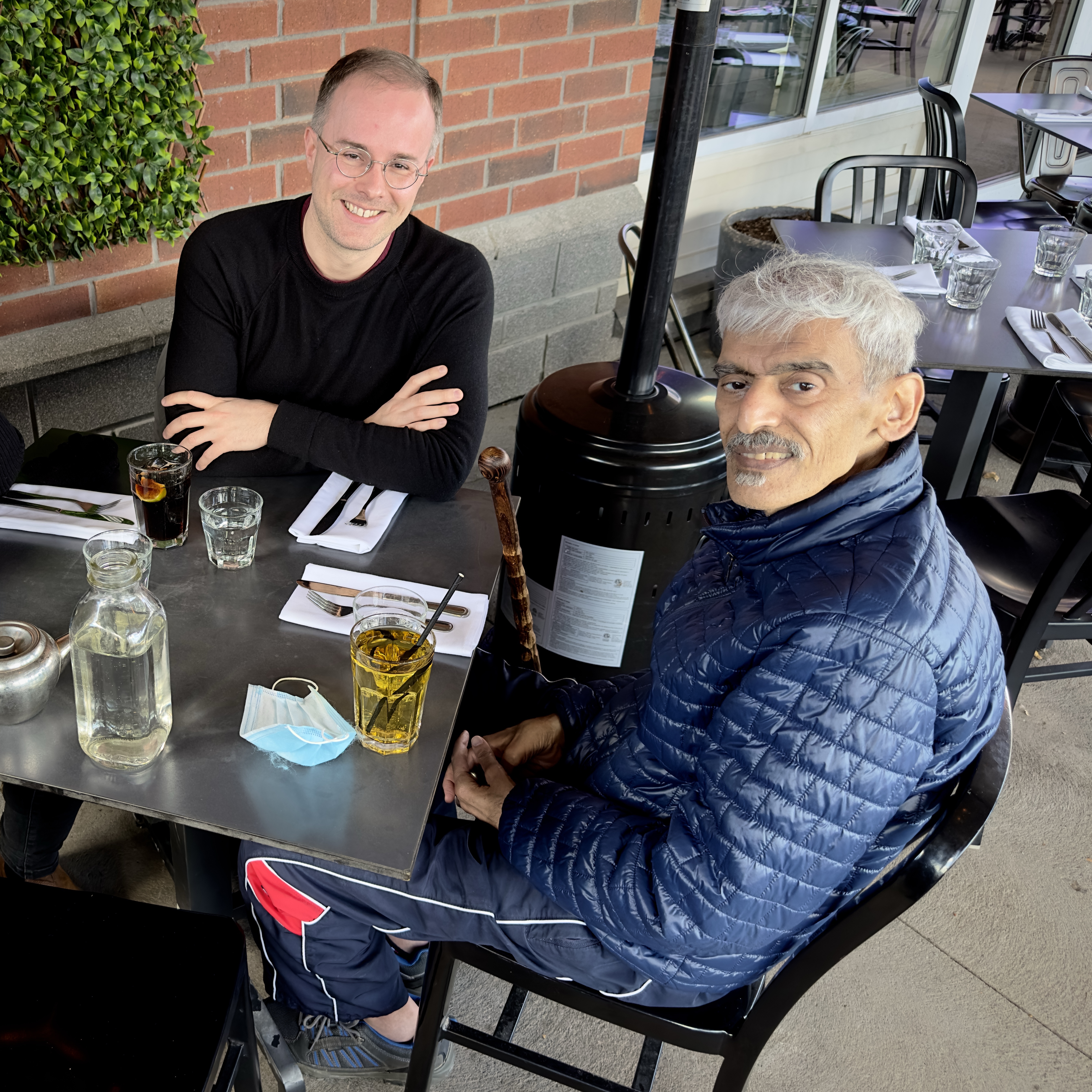
In Memory of Dr. Omid Payrow Shabani

Prof. Omid Payrow Shabani and Christopher Parsons. Guelph. 2023.

Prof. Abdollah (Omid) Payrow Shabani is responsible for much of my career and the unfolding of my life. We met in 2004 when he taught me my first political philosophy course, which focused on Kant’s political writings. I took a significant number of courses with him, and Omid was both my honour’s thesis advisor and Master’s advisor.

Under Omid I spent some of the most intellectually formative years of my life and contemplated the nature of democracy, the roles of free and open communication in enabling and supporting political action, and the importance of privacy for democratic traditions in a digital era. The evolution of technology and self-apparent need to foster and maintain democratic traditions since then have only underscored my commitment to a Habermasian worldview that I learned and developed under his tutelage.

The very way that I see the world — politically, ethically, normatively, and epistemologically — are tightly linked to the time that I studied with Omid. In classes I took with him he embedded in me the need to understand the pragmatic political roles of religion in secular and multicultural political societies, the practice and value of being rigorous and fair to arguments with which we might disagree, the obligation to be open and inclusive to political and normative change, the critical role of expanding our understanding of equity to foster more inclusive politics and societies, and much more.

Since I completed my degrees with Omid I’ve moved on from the formal study of philosophy to undertake more applied academic, political, and policy work. He was always supportive of my ambitions and decisions though, at the same time, he regularly did his best to draw me back to the study of philosophy proper. He always had a paper to share or other academics to whom I should reach out.

As someone who had to flee Iran as a political refugee, Omid was persistently committed to a free and democratic Iran. I remember his stories, of how he was put at risk because of his love of philosophy and in some of his efforts to foster and support democracy in his native state. Democracy, I learned from Omid, was not a word but a practice to which we must remain committed even when that practice may seem futile or hopeless or too lethargic to address the crises of our time. His own practice was a marathon and never a sprint.

If there is a central and guiding lesson of political change that Omid gave me, and I can leave with others seeking such change, it is this: if you adjust a single comma, a logical operator, or placement of a word in law or regulation then you will have led an immensely politically active life. He always somehow had hope when I spoke with him that we can work towards such change, we can be engaged, and we can improve the state of our democracies. This is the power of individuals and communities, made possible in even our flawed democracies. And we can do so with dry humour, fierce passion, and unwavering integrity.

As I think about Omid and the state of the world, today, I only hope that enough of us have the courage, bravery, and grit to work towards changing a comma here or there. Or at least supporting those with the power and influence to do so. Such hopeful ambition continues to be what drives me each day that I wake up to participate in our shared practice of democracy.

Dr. Abdollah (Omid) Payrow Shabani, Professor of Philosophy at the University of Guelph, was 61 years old when he passed away in December of 2023. His name and legacy will live on in his family, his loved ones, and his students.

Farewell, Omid. I will miss, and remember, you forever.

Beyond Privacy: Articulating the Broader Harms of Pervasive Mass Surveillance

2852616711_57c5d04259_b

I’ve published a new paper titled “Beyond Privacy: Articulating the Broader Harms of Pervasive Mass Surveillance” in Media and Communication. Media and Communication is an open access journal; you can download the article from any location, to any computer, free of cost. The paper explores how dominant theories of privacy grapple with the pervasive mass surveillance activities undertaken by western signals intelligence activities, including those of the NSA, CSE, GCHQ, GCSB, and ASD. I ultimately argue that while these theories provide some recourse to individuals and communities, they are not sufficiently holistic to account for how mass surveillance affects the most basic elements a democracy. As such, I suggest that academic critics of signals intelligence activities can avail themselves to theory from the Frankfurt School to more expansively examine and critique contemporary signals intelligence surveillance practices.

Full Abstract

This article begins by recounting a series of mass surveillance practices conducted by members of the “Five Eyes” spying alliance. While boundary- and intersubjectivity-based theories of privacy register some of the harms linked to such practices I demonstrate how neither are holistically capable of registering these harms. Given these theories’ deficiencies I argue that critiques of signals intelligence surveillance practices can be better grounded on why the practices intrude on basic communicative rights, including those related to privacy. The crux of the argument is that pervasive mass surveillance erodes essential boundaries between public and private spheres by compromising populations’ abilities to freely communicate with one another and, in the process, erodes the integrity of democratic processes and institutions. Such erosions are captured as privacy violations but, ultimately, are more destructive to the fabric of society than are registered by theories of privacy alone. After demonstrating the value of adopting a communicative rights approach to critique signals intelligence surveillance I conclude by arguing that this approach also lets us clarify the international normative implications of such surveillance, that it provides a novel way of conceptualizing legal harm linked to the surveillance, and that it showcases the overall value of focusing on the implications of interfering with communications first, and as such interferences constituting privacy violations second. Ultimately, by adopting this Habermasian inspired mode of analysis we can develop more holistic ways of conceptualizing harms associated with signals intelligence practices than are provided by either boundary- or intersubjective-based theories of privacy.

Download the Paper

Photo credit: Retro Printers by Steven Mileham (CC BY-NC 2.0) https://flic.kr/p/5m5pyK

On a Social Networking Bill of Rights

I attended this year’s Computers, Freedom, and Privacy conference and spent time in sessions on privacy in large data sets, deep packet inspection and network neutrality, the role of privacy in venture capital pitches, and what businesses are doing to secure privacy. In addition, a collection of us worked for some time to produce a rough draft of the Social Network Users’ Bill of Rights that was subsequently discussed and ratified by the conference participants. In this post, I want to speak to the motivations of the Bill of Rights, characteristics of social networking and Bill proper, a few hopeful outcomes resulting from the Bill’s instantiation and conclude by denoting a concerns around the Bill’s creation and consequent challenges for moving it forward.

First, let me speak to the motivation behind the Bill. Social networking environments are increasingly becoming the places where individuals store key information – contact information, photos, thoughts and reflections, video – and genuinely becoming integrated into the political. This integration was particularly poignantly demonstrated last year when the American State Department asked Twitter to delay upgrades that would disrupt service and stem the information flowing out of Iran following the illegitimate election of President Ahmadinejad. Social networks have already been tied into the economic and social landscapes in profound ways: we see infrastructure costs for maintaining core business functionality approaching zero and the labor that was historically required for initiating conversations and meetings, to say nothing of shared authorship, have been integrated into social networking platforms themselves. Social networking, under this rubric, extends beyond sites such as Facebook and MySpace, and encapsulate companies like Google and Yahoo!, WordPress, and Digg, and their associated product offerings. Social networking extends well beyond social media; we can turn to Mashable’s collection of twenty characteristics included in the term ‘social networking’ for guidance as to what the term captures:

Continue reading