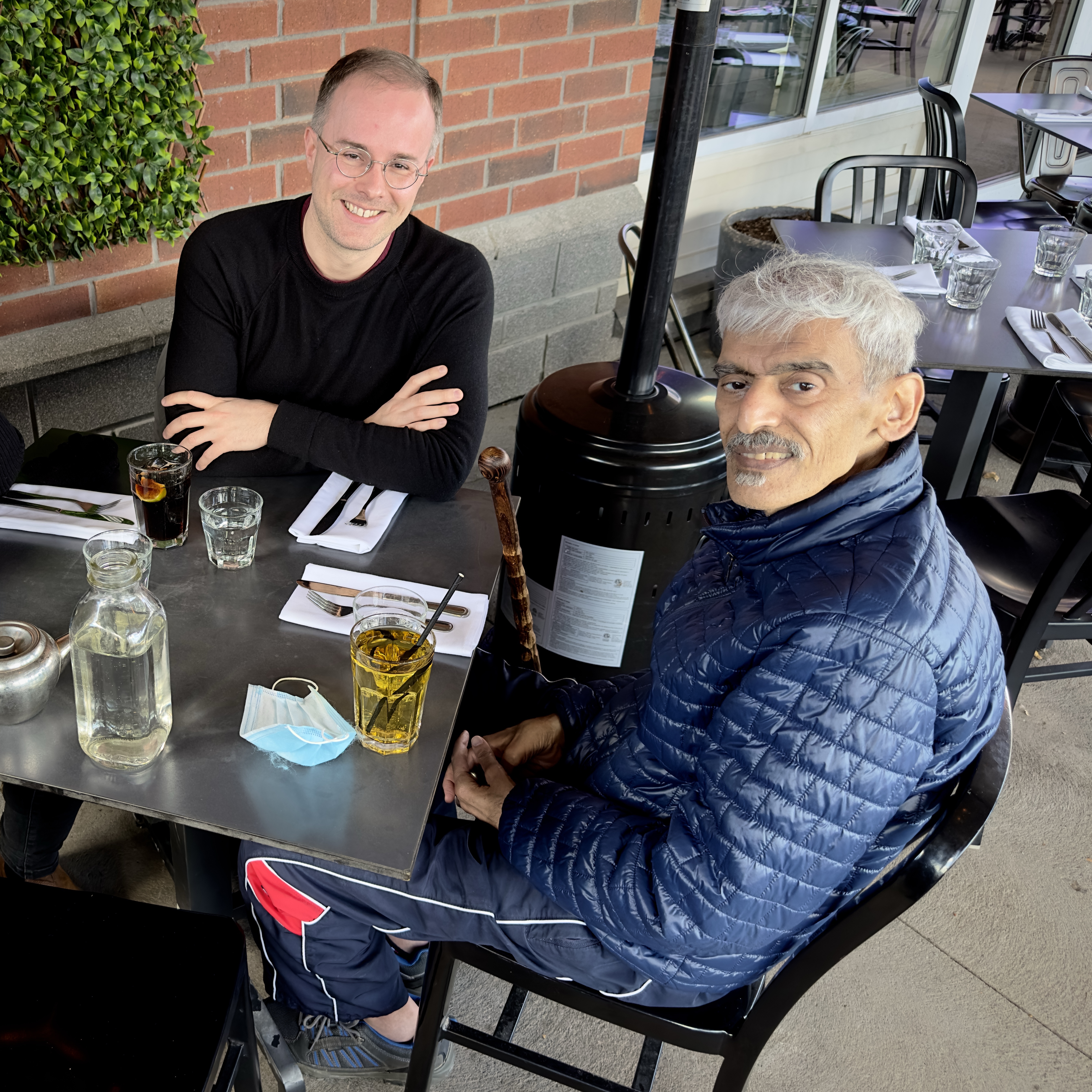
In Memory of Dr. Omid Payrow Shabani

Prof. Omid Payrow Shabani and Christopher Parsons. Guelph. 2023.

Prof. Abdollah (Omid) Payrow Shabani is responsible for much of my career and the unfolding of my life. We met in 2004 when he taught me my first political philosophy course, which focused on Kant’s political writings. I took a significant number of courses with him, and Omid was both my honour’s thesis advisor and Master’s advisor.

Under Omid I spent some of the most intellectually formative years of my life and contemplated the nature of democracy, the roles of free and open communication in enabling and supporting political action, and the importance of privacy for democratic traditions in a digital era. The evolution of technology and self-apparent need to foster and maintain democratic traditions since then have only underscored my commitment to a Habermasian worldview that I learned and developed under his tutelage.

The very way that I see the world — politically, ethically, normatively, and epistemologically — are tightly linked to the time that I studied with Omid. In classes I took with him he embedded in me the need to understand the pragmatic political roles of religion in secular and multicultural political societies, the practice and value of being rigorous and fair to arguments with which we might disagree, the obligation to be open and inclusive to political and normative change, the critical role of expanding our understanding of equity to foster more inclusive politics and societies, and much more.

Since I completed my degrees with Omid I’ve moved on from the formal study of philosophy to undertake more applied academic, political, and policy work. He was always supportive of my ambitions and decisions though, at the same time, he regularly did his best to draw me back to the study of philosophy proper. He always had a paper to share or other academics to whom I should reach out.

As someone who had to flee Iran as a political refugee, Omid was persistently committed to a free and democratic Iran. I remember his stories, of how he was put at risk because of his love of philosophy and in some of his efforts to foster and support democracy in his native state. Democracy, I learned from Omid, was not a word but a practice to which we must remain committed even when that practice may seem futile or hopeless or too lethargic to address the crises of our time. His own practice was a marathon and never a sprint.

If there is a central and guiding lesson of political change that Omid gave me, and I can leave with others seeking such change, it is this: if you adjust a single comma, a logical operator, or placement of a word in law or regulation then you will have led an immensely politically active life. He always somehow had hope when I spoke with him that we can work towards such change, we can be engaged, and we can improve the state of our democracies. This is the power of individuals and communities, made possible in even our flawed democracies. And we can do so with dry humour, fierce passion, and unwavering integrity.

As I think about Omid and the state of the world, today, I only hope that enough of us have the courage, bravery, and grit to work towards changing a comma here or there. Or at least supporting those with the power and influence to do so. Such hopeful ambition continues to be what drives me each day that I wake up to participate in our shared practice of democracy.

Dr. Abdollah (Omid) Payrow Shabani, Professor of Philosophy at the University of Guelph, was 61 years old when he passed away in December of 2023. His name and legacy will live on in his family, his loved ones, and his students.

Farewell, Omid. I will miss, and remember, you forever.

Statement About the Attack in the University of Waterloo’s Gender Issues Philosophy Course

My personal career is significantly defined by the feminist philosophy classes that I took as an undergraduate and graduate student. That education taught me essential critiques about scientific objectivity and the standpoints of knowledge creators, offered broader critical thinking skills, and revealed how power structures have historically been architected to silence or appropriate women’s contributions to Western scientific and political development. To this day those classes inform all of the personal and professional activities in which I am involved.

It is with this explicitly in mind that I am horrified by the hateful attack that recently took place at the University of Waterloo, where junior faculty and students alike were violently assaulted because they cared about learning about gender and philosophy. This could have been myself or many of my friends or supervising faculty in years past.

CSIS has identified non-religious extremism as one of the most significant threats to Canada’s national security. And faculty and students at the University of Waterloo have experienced this first-hand after being attacked and made to experience fear for simply wanting to learn about the relationship between gender and the formation of power, knowledge, or socially constructed reality.

Misogyny, oppression, and racism are realities in Canada, and Canadians need to talk more openly and frequently about it. These cannot be fixed overnight but, instead, are challenges that require sustained and often inglorious work to correct. At its core, this work demands critically assessing institutions’ and organizations’ pasts, recognizing and righting historical wrongs, and adjusting power and social structures to reflect a more just and fair present and future.

I would encourage our leaders to take these threats and issues seriously, and to continue to meaningfully work to combat the hateful underlying ideology that lies behind these violent and malevolent actions. Some leaders in politics, workplaces, and social groups are clearly acting to address these issues, but they must be joined by all leaders at every level of society. Doing anything else betrays all who live in Canada while exhibiting a failure of leadership, and ceding the moral gravitas that is required to lead our businesses, institutions, agencies, and communities.

Review of The Offensive Internet: Speech, Privacy, and Reputation

9780674050891-lgThe Offensive Internet: Speech, Privacy, and Reputation is an essential addition to academic, legal, and professional literatures on the prospective harms raised by Web 2.0 and social networking sites more specifically. Levmore and Nussbaum (eds.) have drawn together high profile legal scholars, philosophers, and lawyers to trace the dimensions of how the Internet can cause harm, with a focus on the United States’ legal code to understand what enables harm and how to mitigate harm in the future. The editors have divided the book into four sections – ‘The Internet and Its Problems’, ‘Reputation’, ‘Speech’, and ‘Privacy’ – and included a total of thirteen contributions. On the whole, the collection is strong (even if I happen to disagree with many of the policy and legal changes that many authors call for).

In this review I want to cover the particularly notable elements of the book and then move to a meta-critique of the book. Specifically, I critique how some authors perceive the Internet as an ‘extra’ that lacks significant difference from earlier modes of disseminating information, as well as the position that the Internet is a somehow a less real/authentic environment for people to work, play, and communicate within. If you read no further, leave with this: this is an excellent, well crafted, edited volume and I highly recommend it.

Continue reading

Deep Packet Inspection and the Confluence of Privacy Regimes

insiderouterI learned today that I was successful in winning a Social Sciences and Human Research Council (SSHRC) award. (Edit September 2009: I’ve been upgraded to a Joseph Armand Bombardier Canada Graduate Scholarship). Given how difficult I found it to find successful research statements (save for through personal contacts) I wanted to post my own statement for others to look at (as well as download if they so choose). Since writing the below statement, some of my thoughts on DPI have become more nuanced, and I’ll be interested in reflecting on how ethics might relate to surveillance/privacy practices. Comments and ideas are, of course, welcomed.

Interrogating Internet Service Provider Surveillance:
Deep Packet Inspection and the Confluence of International Privacy Regimes

Context and Research Question

Internet Service Providers (ISPs) are ideally situated to survey data traffic because all traffic to and from the Internet must pass through their networks. Using sophisticated data traffic monitoring technologies, these companies investigate and capture the content of unencrypted digital communications (e.g. MSN messages and e-mail). Despite their role as the digital era’s gatekeepers, very little work has been done in the social sciences to examine the relationship between the surveillance technologies that ISPs use to survey data flows and the regional privacy regulations that adjudicate permissible degrees of ISP surveillance. With my seven years of employment in the field of Information Technology (the last several in network operations), and my strong background in conceptions of privacy and their empirical realization from my master’s degree in philosophy and current doctoral work in political science, I am unusually well-suited suited to investigate this relationship. I will bring this background to bear when answering the following interlinked questions in my dissertation: What are the modes and conditions of ISP surveillance in the privacy regimes of Canada, the US, and European Union (EU)? Do common policy structures across these privacy regimes engender common realizations of ISP surveillance techniques and practices, or do regional privacy regulations pertaining to DPI technologies preclude any such harmonization?

Continue reading

Privacy, Dignity, Copyright and Twitter

privacyfield[Note: this is an early draft of a section of a paper I’m working on titled ‘Who Gives a Tweet about Privacy’. Other sections will follow as I draft them.]

Unauthorized Capture and Transmission of Data

Almost every cellular phone that is now sold has a camera of some sort embedded into it. The potential for individuals to capture and transmit our image without permission has become a common fact of contemporary Western life, but this has not always been the case. When Polaroid cameras were new and first used to capture images of indiscretions for gossip columns, Warren and Brandeis wrote an article asserting that the unauthorized capture and transmission of photos and gossip constituted a privacy violation. Such transmissions threatened to destroy “at once robustness of thought and delicacy of feeling. No enthusiasm can flourish, no generous impulse can survive under [gossip’s] blighting influence” (Warren and Brandeis 1984: 77). Individuals must be able to expect that certain matters will be kept private, even when acting in public spaces – they have a right to be let alone – or else society will reverse its progress towards civilization.

Continue reading

So…You Want to Redefine ‘Privacy’, eh?

There has been a sustained argument across the ‘net and in traditional circles, that privacy is being redefined before our very eyes. Oftentimes, we see how a word transforms by studying its etymology – this is helpful in understanding the basis of the words that we utter. What do we do, however, when we work to redefine not just a word’s definition (such as what the term ‘cool’ refers to) but its normative horizons?

In redefining the work ‘privacy’ to account for how people are empirically protecting their privacy, are we redefining the word, or the normative horizon that it captures? Moreover, can we genuinely assume that the term’s normative guide is changing simply because of recent rapid changes in technology increase the difficulty in exercising our right to privacy in digitized environments? To argue that these normative boundaries are shifting largely because of how digital networks have been programmed presupposes that the networks cannot be designed in any other way, that digital content will flow as it does now the same way that gravity acts on our physical bodies as it presently does. The difficulty in maintaining such an analogy is that it assumes that there are natural laws to an immanent programming languages that structure how we can participate in digital environments.

Continue reading