‘Defending the Core’ of the Network: Canadian vs. American Approaches

U.S. Cyber Command recently conducted on Fort Meade its first exercise in collaboration with cyber subject-matter experts from across the National Security Agency, National Guard, Department of Homeland Security and FBI.In our recent report, “The Governance of Telecommunications Surveillance: How Opaque and Unaccountable Practices and Policies Threaten Canadians,” we discussed how the Communications Security Establishment (CSE) developed and deployed a sensor network within domestic and foreign telecommunications networks. While our report highlighted some of the concerns linked to this EONBLUE sensor network, including the dangers of secretly extending government surveillance capacity without any public debate about the extensions, as well as how EONBLUE or other CSE programs programs collect information about Canadians’ communications, we did not engage in a comparison of how Canada and its closest allies monitor domestic network traffic. This post briefly describes the EONBLUE sensor program, what may be equivalent domestic programs in the United States, and the questions that emerge from contrasting what we know about the Canadian and American sensor networks.

What is EONBLUE?

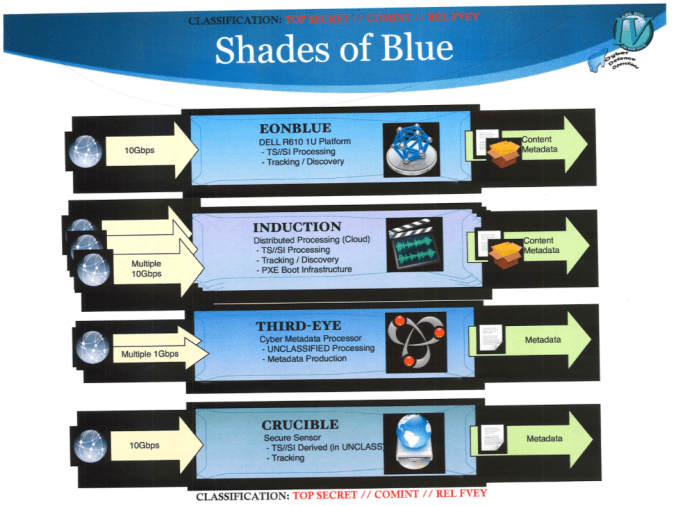
EONBLUE was developed and deployed by the CSE. The CSE is Canada’s premier signals intelligence agency. The EONBLUE sensor network “is a passive SIGINT system that was used to collect ‘full-take’ data, as well as conduct signature and anomaly based detections on network traffic.” Prior Snowden documents showcased plans to integrate EONBLUE into government networks; the network has already been integrated into private companies’  networks. Figure one outlines the different ‘shades of blue’, or variations of the EONBLUE sensors:

EONBLUE Sensors

Continue reading

The Governance of Telecommunications Surveillance

Last week I released a new report, The Governance of Telecommunications Surveillance: How Opaque and Unaccountable Practices and Policies Threaten Canadians, through the Telecommunications Transparency Project. The Project is associated with the Citizen Lab, an interdisciplinary laboratory based at the Munk School of Global Affairs, University of Toronto, and the report was funded through the Canadian Internet Registration Authorities’s .CA Community Investment Program.

The report examines how contemporary telecommunications surveillance is governed in Canada. In it, we ask how much telecommunications surveillance is occurring in Canada, what actors are enabling the surveillance, to what degree those actors disclose their involvement in (and the magnitude of) surveillance, and what degree of oversight is given to the federal governments’ surveillance practices. We conclude that serious failures in transparency and accountability indicate that corporations are failing to manage Canadians’ personal information responsibly and that government irresponsibility surrounding accountability strains its credibility and aggravates citizens’ cynicism about the political process. In aggregate, these failings endanger both the development of Canada’s digital economy and aggravate the democratic deficit between citizens and their governments.

Continue reading

New Update to the SIGINT Summaries

Grondstation van de Nationale SIGINT Organisatie (NSO) in Burum, Frysl‚nI have added one new item to the SIGINT Summaries page. The Summaries include downloadable copies of leaked Communications Security Establishment (CSE) documents, along with summary, publication, and original source information.1 CSE is Canada’s foreign signals intelligence agency and has operated since the Second World War.

Documents were often produced by CSE’s closest partners which, collectively, form the ‘Five Eyes’ intelligence network. This network includes the CSE, the National Security Agency (NSA), the Government Communications Headquarters (GCHQ), Australian Signals Directorate (ASD),2 and Government Communications Security Bureau (GCSB)).

All of the documents are available for download from this website. Though I am hosting the documents they were all first published by another party. The new documents and their summaries are listed below. The full list of documents and their summary information is available on the Canadian SIGINT Summaries page.

The new contribution comes from documents released by CBC and covers how Five Eyes intelligence analysts correlated telephony and mobile Internet communications information. For the first time I have noted, in the summary block, all of the codenames that were mentioned in the redacted document.

Synergising Network Analysis Tradecraft: Network Tradecraft Advancement Team (NTAT)

Summary: This slide deck showcases some of the activities, and successes, of the Network Tradecraft Advancement Team (NTAT). The slides focus on how to develop and document tradecraft which is used to correlate telephony and Internet data. Two separate workshops are discussed, one in 2011 and another in 2012. Workshop outcomes included identifying potentially converged data (between telephony and Internet data) as well as geolocating mobile phone application servers. A common mobile gateway identification analytic was adopted by three agencies, including DSD. NTAT had also adopted the CRAFTY SHACK tradecraft documentation system over the courses of these workshops.

In an experiment, codenamed IRRITANT HORN, analysts explored whether they could identify connections between a potentially ‘revolutionary’ country and mobile applications servers. They successfully correlated connections with application servers which opened up the potential to conduct Man in the Middle attacks or effect operations towards the mobile devices, as well as the potential to harvest data in transit and at rest from the devices. In the profiling of mobile applications servers it appears that EONBLUE was used to collect information about a company named Poynt; that company’s application was being used by Blackberry users, and the servers profiled were located in Calgary, Alberta (Canada).

The agencies successfully found vulnerabilities in UCWeb, which was found to leak IMSI, MSISDN, IMEI, and other device characteristics. These vulnerabilities were used to discover a target and it was determined that the vulnerabilities might let a SIGINT agency serve malware to the target. A ‘microplugin’ for XKeyscore was developed so that analysts could quickly surface UCWeb-related SIGINT material. (NOTE: The Citizen Lab analyzed later versions of UCWeb and found vulnerabilities that were subsequently patched by the company. For more, see: “A Chatty Squirrel: Privacy and Security Issues with UC Browser.”)

Document Published: May 21, 2015
Document Dated: 2012 or later
Document Length: 52 pages (slides plus notes)
Associated Article: Spy agencies target mobile phones, app stores to implant spyware
Download Document: Synergising Network Analysis Tradecraft: Network Tradecraft Advancement Team (NTAT)
Codenames mentioned: ATLAS, ATHENA, BLAZING SADDLES, CRAFTY SHACK, DANAUS, EONBLUE, FRETTING YETI, HYPERION, IRRITANT HORN, MASTERSHAKE, PEITHO, PLINK, SCORPIOFORE

Footnotes


  1.  Formally known as the Communications Security Establishment Canada (CSEC). 
  2.  The ASD was formerly known as the Defence Signals Directorate (DSD). 

The Canadian SIGINT Summaries

Grondstation van de Nationale SIGINT Organisatie (NSO) in Burum, FryslânJournalists with access to leaked documents have reported on the partnerships and activities undertaken by Canada’s foreign signals intelligence (SIGINT) agency, the Communications Security Establishment (CSE), since October 2013. As a result of their stories we know that the Canadian government hosts collection facilities in its diplomatic outposts for American SIGINT operations, has co-ordinated with the NSA to monitor for threats to international summits that took place in Canada, and shares a cooperative relationship with the National Security Agency (NSA) to protect North America from foreign threats. CSE, itself, was found to be conducting signals intelligence and development operations against the Brazilian government, running experiments using domestically collected metadata to track Canadians’ devices, and automating both the discovery of vulnerable computer devices on the Internet for later exploitation and identifying network administrators’ Internet traffic.

The aforementioned revelations are just a sample of what Canadians have learned as journalists have reported on documents leaked to them by Edward Snowden and other whistleblowers. But it has been challenging for even experts to keep track of the Canadian discoveries amongst the tidal wave of information concerning American and British SIGINT agencies. I have created and published a resource to help researchers and members of the public alike track mentions of CSE in documents that have been reported on by professional journalists.

The Canadian SIGINT Summaries page of this website currently includes downloadable copies, along with summary, publication, and original source information, of leaked CSE documents. The page will be updated  as new whistleblower documents are released and as I parse and add information about CSE’s operational guides that have been released to the public under Access to Information and Privacy (ATIP) laws. I plan to also include copies of the CSE Commissioner’s reports. While I will try to exhaustively collate documents it is entirely possible that I have, or will, miss some; if you believe I have failed to include a primary document and would like me to add it to the SIGINT Summaries page please contact me with the document and a link to the journalistic source which reported on it.

The Canadian SIGINT Summaries are not meant to replace the detailed reporting of documents nor the exhaustive examination of them by other researchers, scholars, or other analysts. And I expect to write more extensive analyses based upon the documents that extend beyond my summarizations of them. The Canadian SIGINT Summaries are meant as a public resource, listing all of the relevant public documents, briefly describing their contents and publication data, and letting readers download them to draw their own conclusions.

As I update the page with new items or sections I will publish blog posts which either include the item (if just one or two are added) or short summaries when larger updates are published. I hope that you find the Canadian SIGINT Summaries helpful and, for international visitors, encourage you to replicate this model to summarize information about your own domestic SIGINT agency.

Microsoft’s OneDrive Storage Expands NSA Surveillance

spigget_dispersive_prism_illustration

Earlier this month Microsoft announced that its Office 365 subscribers would be able to upload an unlimited amount of data into Microsoft’s cloud-based infrastructure. Microsoft notes that the unlimited data storage capacity is:

just one small part of our broader promise to deliver a single experience across work and life that helps people store, sync, share, and collaborate on all the files that are important to them, all while meeting the security and compliance needs of even the most stringent organizations.

Previously, subscribers could store up to 1TB of data in OneDrive. The new, unlimited storage model, creates new potential uses of the Microsoft cloud including even “wholesale backup of their computer hard drives, or even of their local backup drives”. And, given OneDrive’s integration with contemporary Windows operating systems there is the opportunity for individuals to expand what they store to the Cloud so it can be accessed on other devices.

While the expanded storage space may be useful to some individuals and organizations, it’s important to question Microsoft’s assertion that OneDrive meets the most stringent organization’s security and compliance needs. One reason to question these assertions arise out of a memo that was disclosed by National Security Agency (NSA) whistleblower Edward Snowden. The memo revealed that:

NSA Memo on Microsoft enabling SIGINT Access to SkyDrive

As summarized by the Electronic Frontier Foundation, Section 702 of the FISA Amendments Act which is mentioned in the NSA memo is extremely permissive. The section has been used to authorize:

  • collection of Americans’ phone records without a warrant;
  • access to large portions of Internet traffic that moves through American servers;
  • disclosure of collected information to other parties (e.g. the Drug Enforcement Agency);

European policy analysts agree that Section 702 is overly permissive(.pdf) and argue that the definitions used in the section are so general that “any data of assistance to US foreign policy is eligible, including expressly political surveillance over ordinary lawful democratic activities.” The scope of surveillance was made worse as a result of the FISA Amendments Act 2008. While the FAA 2008 is perhaps best known for providing legal immunity to companies which participated in the warrantless wiretapping scandal, it also expanded the scope of NSA surveillance. Specifically:

[b]y introducing “remote computing services” (a term defined in ECPA 1986 dealing with law enforcement access to stored communications), the scope was dramatically widened communications and telephony to include Cloud computing (.pdf source).

Microsoft’s expansion of OneDrive storage limits is meant to enhance its existing consumer cloud offerings. And such cloud storage can produce workplace efficiencies by simplifying access to documents, protecting against device loss, and externalizing some security-related challenges.

However, if subscribers take advantage of the new unlimited storage and send ever-increasing amounts of data into Microsoft’s cloud, then there will be a much greater amount of information that is readily available to the NSA (and other allied SIGINT agencies). And given that Section 702 authorizes surveillance of foreign political activities there is a real likelihood that data content which was previously more challenging for NSA to access will now be more readily available to interception and analysis.

Signals intelligence agencies, such as the NSA, are likely not top of mind threats to individuals around the world. However, Microsoft’s willingness to manufacture government access to personal and business data should give people pause before they generate sensitive documents, share or store intimate photos, or otherwise place important data in Microsoft’s cloud infrastructure. Any company so willing to engineer its users’ privacy out of personal and enterprise services alike must be treated with a degree of suspicion and its product announcement and security assurances with extremely high levels of skepticism.

It’s Time for BlackBerry to Come Clean

BlackBerry N10On April 10, 2014, Blackberry’s enterprise chief publicly stated that his company had no intention of releasing transparency reports concerning how often, and under what terms, the company has disclosed Blackberry users’ personal information to government agencies. BlackBerry’s lack of transparency stands in direct contrast to its competitors: Google began releasing transparency reports in 2009, and Apple and Microsoft in 2013. And BlackBerry’s competitors are rigorously competing on personal privacy as well, with Apple recently redesigning their operating system to render the company unable to decrypt iDevices for government agencies and having previously limited its ability to decrypt iMessage communications. Google will soon be following Apple’s lead.

So, while Blackberry’s competitors are making government access to telecommunications data transparent to consumers and working to enhance their users’ privacy, BlackBerry remains tight-lipped about how it collaborates with government agencies. And as BlackBerry attempts to re-assert itself in the enterprise market — and largely cede the consumer market to its competitors — it is unclear how it can alleviate business customers’ worries about governments accessing BlackBerry-transited business information. Barring the exceptional situation where data from BlackBerry’s network is introduced as evidence in a court process businesses have no real insight of the extent to which Blackberry is compelled to act against its users’ interests by disclosing information to government agencies. And given that the company both owns an underlying patent for, and integrated into its devices’ VPN client, a cryptographic algorithm believed vulnerable to surreptitious government spying it’s not enough to simply refuse to comment on why, and the extent to which, BlackBerry is compelled to help governments spy on its customer base.

We know that BlackBerry has been legally and politically bludgeoned into developing, implementing, and providing training courses on intercepting and censoring communications sent over its network. At the same time, we know that many employees at BlackBerry genuinely care about developing secure products and delivering them to the world; reliable, secure, and productive communications products are ostensibly the lifeblood that keeps the company afloat. So why, knowing what we know about the company’s ethos and the surveillance compulsions it has faced in the past, is it so unwilling to be honest with its current and prospective enterprise customers and develop transparency reports: for fear that customers would flee the company upon realizing the extent to which BlackBerry communications are accessed or monitored by governments, because of gag-orders they’ve agreed to in order to sell products in less-democratic nations, or just because they hold their customers is contempt?