 Edward Snowden’s revelations have made it incredibly obvious that signals intelligence agencies have focused a lot of their time and energy in tracking people as they browse the web. Such tracking is often possible at a global scale because so much of the data that crosses the Internet is unencrypted. Fortunately, the ease of such surveillance is being curtailed by large corporations and advocacy organizations alike.
Today, WhatsApp and Open Whisper Systems announced they have been providing, and will continue to deploy, what’s called ‘end to end’ encryption to WhatsApp users. This form of encryption ensures that the contents of subscribers’ communications are be secured from third-party content monitoring as it transits from a sender’s phone to a recipient’s device.
As a result of these actions, WhatsApp users will enjoy a massive boost in their communications security. And it demonstrates that Facebook, the owner of WhatsApp, is willing to enhance the security of its users even when such actions are likely to provoke and upset surveillance-hawks around the world who are more interested in spying on Facebook and WhatsApp subscribers than in protecting them from surveillance.
A separate, but thematically related, blog post the Electronic Frontier Foundation announced the creation of a new Certificate Authority (CA) initiative called ‘Let’s Encrypt’. Partnering with the Electronic Frontier Foundation are Mozilla, Cisco, Akamai, Identrust, and researchers at the University of Michigan. CAs issue the data files that are used to cryptographically secure communications between clients (like your web browser) and servers (like EFF.org). Such encryption makes it more challenging for another party to monitor what you are sending to, and receiving from, a server you are visiting.
Key to the ‘Let’s Encrypt’ initiative is that the issued certificates will be free and installable using a script. The script is meant to automate the process of requesting, configuring, and installing the certificate. Ideally, this will mean that people with relatively little experience will be able to safely and securely set up SSL-protected websites. Academic studies have shown that even those with experience routinely fail to properly configure SSL-protections.
The aim of both of these initiatives is to increase the ‘friction’, or relative difficulty, in massively monitoring chat and web-based communications. However, it is important to recognize that neither initiative can be considered a perfect solution to surveillance.
In the case of WhatsApp and Open Whisper Systems, end to end encryption does not fix the broader problems of mobile security: if an adversary can take control of a mobile device, or has a way of capturing text that is typed into or that is displayed on the screen when you’re using WhatsApp, then any message sent or received by the device could be susceptible to surveillance. However, there is no evidence that any government agency in the world has monitored, or is currently capable of monitoring, millions or billions of devices simultaneously. There is evidence, however, of government agencies aggressively trying to monitor the servers and Internet infrastructure that applications like WhatsApp use in delivering messages between mobile devices.
Moreover, it’s unclear what Facebook’s or WhatsApp’s reaction would be if a government agency tried to force the delivery of a cryptographically broken or weakened version of WhatsApp to particular subscribers using orders issued by American, European, or Canadian courts. And, even if the companies in question fought back, what would they do if they lost the court case?
Similarly, the ‘Let’s Encrypt’ initiative relies on a mode of securing the Internet that is potentially susceptible to state interference. Governments or parties affiliated with governments have had certificates falsely issued in order to monitor communications between client devices (e.g. smartphones) and servers (e.g. Gmail). Moreover, professional developers have misconfigured commerce backends to the effect of not checking whether the certificate used to encrypt a communication belong to the right organization (i.e. not checking that the certificate used to communicate with Paypal actually belongs to Paypal). There are other issues with SSL, including a poor revocation checking mechanism, historical challenges in configuring it properly, and more. Some of these issues may be defrayed by the ‘Let’s Encrypt’ initiative because of the members’ efforts to work with the Decentralized SSL Observatory, scans.io, and Google’s Certificate Authority logs, but the initiative — and the proposals accompanying it — is not a panacea for all of the world’s online encryption problems. But it will hopefully make it more difficult for global-scale surveillance that is largely predicated on monitoring unencrypted communications between servers and clients.
Edward Snowden was deeply concerned that the documents he brought to light would be treated with indifference and that nothing would change despite the documents’ presence in the public record. While people may be interested in having more secure, and more private, communications following his revelations those interests are not necessarily translated into an ability for people to secure their communications. And the position that people must either embark on elaborate training regimes to communicate securely or just not say sensitive things, or visit sensitive places, online simply will not work: information security needs to work with at least some of the tools that people are using in their daily lives while developing new and secure ones. It doesn’t make sense to just abandon the public to their own devices while the ‘professionals’ use hard-to-use ’secured’ systems amongst themselves.
The work of WhatsApp, Facebook, Open Whisper Systems, the Electronic Frontier Foundation, and that other members of the ‘Let’s Encrypt’ initiative can massively reduce the challenges people face when trying to communicate more responsibly. And the initiatives demonstrate how the cryptographic and communications landscape is shifting in the wake of Snowden’s revelations concerning the reality of global-scale surveillance. While encryption was ultimately thrown out of the original design specifications for the Internet it’s great to see that cryptography is starting to get bolted onto the existing Internet in earnest.
 In our recent report, “The Governance of Telecommunications Surveillance: How Opaque and Unaccountable Practices and Policies Threaten Canadians,” we discussed how the Communications Security Establishment (CSE) developed and deployed a sensor network within domestic and foreign telecommunications networks. While our report highlighted some of the concerns linked to this EONBLUE sensor network, including the dangers of secretly extending government surveillance capacity without any public debate about the extensions, as well as how EONBLUE or other CSE programs programs collect information about Canadians’ communications, we did not engage in a comparison of how Canada and its closest allies monitor domestic network traffic. This post briefly describes the EONBLUE sensor program, what may be equivalent domestic programs in the United States, and the questions that emerge from contrasting what we know about the Canadian and American sensor networks.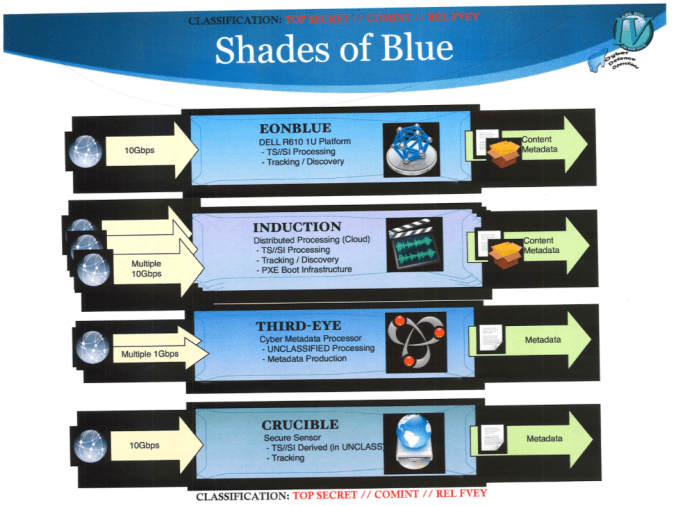
 I have added one new item to the SIGINT Summaries page. The Summaries include downloadable copies of leaked Communications Security Establishment (CSE) documents, along with summary, publication, and original source information.

 Technology, Thoughts & Trinkets