Does Mexico’s Transparency Report Promote Accountability?

7666659340_d3096c746a_k-199x300Red en Defensa de los Derechos Digitales (R3D) has released a report that compares Mexican ISPs’ transparency and privacy practices. The work parallels the Karisma Foundation’s report about Columbian ISPs’ transparency and privacy practices; both the Mexican and Columbian organizations’ reports are based on the Electronic Frontier Foundation’s “Who Has Your Back” reporting format. The format is designed to visually summarize the practices taken by Internet companies so that end-users can easily evaluate how companies protect their users.

This post briefly summarizes R3D’s findings and then proceeds to discuss whether Mexican companies’ transparency report genuinely enable corporate accountability. Based on academic literatures, a strong argument can be made that the aggregated Mexican transparency report that have been issued by the Mexican telecommunications companies does not make the companies particularly accountable to their customers. The post concludes by raising questions about the status of third-party comparisons of corporate privacy and transparency practices: why are intermediaries like R3D, Karisma Foundation, Electronic Frontier Foundation, or IX Maps so important? And what are the deficits of contemporary comparisons of corporate transparency and privacy practices?

Summary of R3D Findings

RD3’s report examines privacy policies and codes of practices from the eight Mexican telecommunications companies that, in aggregate, compose 98% of Mexico’s mobile, fixed line, and broadband markets. Out of a possible six ‘stars’ only one company (Movistar) received two stars (the most of any company); half for requiring a warrant for data requests, half for publishing a transparency report, and a full star for advocating for privacy. The worst company, Megacable, received just a half-star for requiring a warrant for data requests.

Companies could receive either a full star, half-star, quarter-star or no star in each of the categories that are noted in Figure One. The evaluation criteria for receiving these grades follows the figure.

BAC1841D-E5B7-472F-9FB7-1544E3C3D550-1024x554

Continue reading

‘Defending the Core’ of the Network: Canadian vs. American Approaches

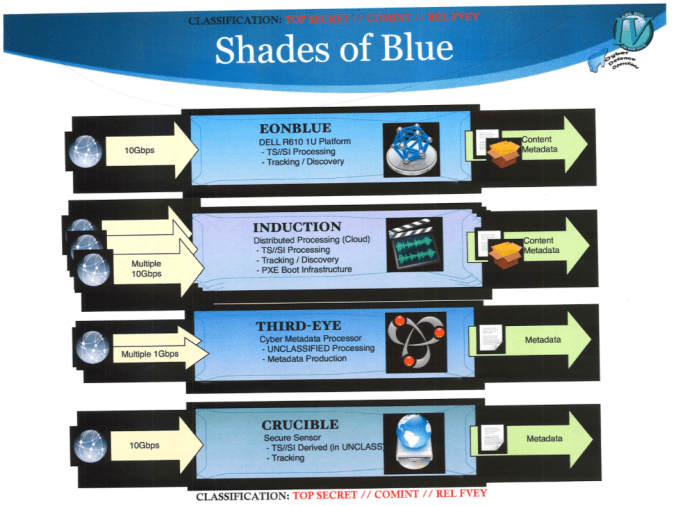
U.S. Cyber Command recently conducted on Fort Meade its first exercise in collaboration with cyber subject-matter experts from across the National Security Agency, National Guard, Department of Homeland Security and FBI.In our recent report, “The Governance of Telecommunications Surveillance: How Opaque and Unaccountable Practices and Policies Threaten Canadians,” we discussed how the Communications Security Establishment (CSE) developed and deployed a sensor network within domestic and foreign telecommunications networks. While our report highlighted some of the concerns linked to this EONBLUE sensor network, including the dangers of secretly extending government surveillance capacity without any public debate about the extensions, as well as how EONBLUE or other CSE programs programs collect information about Canadians’ communications, we did not engage in a comparison of how Canada and its closest allies monitor domestic network traffic. This post briefly describes the EONBLUE sensor program, what may be equivalent domestic programs in the United States, and the questions that emerge from contrasting what we know about the Canadian and American sensor networks.

What is EONBLUE?

EONBLUE was developed and deployed by the CSE. The CSE is Canada’s premier signals intelligence agency. The EONBLUE sensor network “is a passive SIGINT system that was used to collect ‘full-take’ data, as well as conduct signature and anomaly based detections on network traffic.” Prior Snowden documents showcased plans to integrate EONBLUE into government networks; the network has already been integrated into private companies’  networks. Figure one outlines the different ‘shades of blue’, or variations of the EONBLUE sensors:

EONBLUE Sensors

Continue reading

The Governance of Telecommunications Surveillance

Last week I released a new report, The Governance of Telecommunications Surveillance: How Opaque and Unaccountable Practices and Policies Threaten Canadians, through the Telecommunications Transparency Project. The Project is associated with the Citizen Lab, an interdisciplinary laboratory based at the Munk School of Global Affairs, University of Toronto, and the report was funded through the Canadian Internet Registration Authorities’s .CA Community Investment Program.

The report examines how contemporary telecommunications surveillance is governed in Canada. In it, we ask how much telecommunications surveillance is occurring in Canada, what actors are enabling the surveillance, to what degree those actors disclose their involvement in (and the magnitude of) surveillance, and what degree of oversight is given to the federal governments’ surveillance practices. We conclude that serious failures in transparency and accountability indicate that corporations are failing to manage Canadians’ personal information responsibly and that government irresponsibility surrounding accountability strains its credibility and aggravates citizens’ cynicism about the political process. In aggregate, these failings endanger both the development of Canada’s digital economy and aggravate the democratic deficit between citizens and their governments.

Continue reading

New Update to the SIGINT Summaries

Grondstation van de Nationale SIGINT Organisatie (NSO) in Burum, Frysl‚nI have added one new item to the SIGINT Summaries page. The Summaries include downloadable copies of leaked Communications Security Establishment (CSE) documents, along with summary, publication, and original source information.1 CSE is Canada’s foreign signals intelligence agency and has operated since the Second World War.

Documents were often produced by CSE’s closest partners which, collectively, form the ‘Five Eyes’ intelligence network. This network includes the CSE, the National Security Agency (NSA), the Government Communications Headquarters (GCHQ), Australian Signals Directorate (ASD),2 and Government Communications Security Bureau (GCSB)).

All of the documents are available for download from this website. Though I am hosting the documents they were all first published by another party. The new documents and their summaries are listed below. The full list of documents and their summary information is available on the Canadian SIGINT Summaries page.

The new contribution comes from documents released by CBC and covers how Five Eyes intelligence analysts correlated telephony and mobile Internet communications information. For the first time I have noted, in the summary block, all of the codenames that were mentioned in the redacted document.

Synergising Network Analysis Tradecraft: Network Tradecraft Advancement Team (NTAT)

Summary: This slide deck showcases some of the activities, and successes, of the Network Tradecraft Advancement Team (NTAT). The slides focus on how to develop and document tradecraft which is used to correlate telephony and Internet data. Two separate workshops are discussed, one in 2011 and another in 2012. Workshop outcomes included identifying potentially converged data (between telephony and Internet data) as well as geolocating mobile phone application servers. A common mobile gateway identification analytic was adopted by three agencies, including DSD. NTAT had also adopted the CRAFTY SHACK tradecraft documentation system over the courses of these workshops.

In an experiment, codenamed IRRITANT HORN, analysts explored whether they could identify connections between a potentially ‘revolutionary’ country and mobile applications servers. They successfully correlated connections with application servers which opened up the potential to conduct Man in the Middle attacks or effect operations towards the mobile devices, as well as the potential to harvest data in transit and at rest from the devices. In the profiling of mobile applications servers it appears that EONBLUE was used to collect information about a company named Poynt; that company’s application was being used by Blackberry users, and the servers profiled were located in Calgary, Alberta (Canada).

The agencies successfully found vulnerabilities in UCWeb, which was found to leak IMSI, MSISDN, IMEI, and other device characteristics. These vulnerabilities were used to discover a target and it was determined that the vulnerabilities might let a SIGINT agency serve malware to the target. A ‘microplugin’ for XKeyscore was developed so that analysts could quickly surface UCWeb-related SIGINT material. (NOTE: The Citizen Lab analyzed later versions of UCWeb and found vulnerabilities that were subsequently patched by the company. For more, see: “A Chatty Squirrel: Privacy and Security Issues with UC Browser.”)

Document Published: May 21, 2015
Document Dated: 2012 or later
Document Length: 52 pages (slides plus notes)
Associated Article: Spy agencies target mobile phones, app stores to implant spyware
Download Document: Synergising Network Analysis Tradecraft: Network Tradecraft Advancement Team (NTAT)
Codenames mentioned: ATLAS, ATHENA, BLAZING SADDLES, CRAFTY SHACK, DANAUS, EONBLUE, FRETTING YETI, HYPERION, IRRITANT HORN, MASTERSHAKE, PEITHO, PLINK, SCORPIOFORE

Footnotes


  1.  Formally known as the Communications Security Establishment Canada (CSEC). 
  2.  The ASD was formerly known as the Defence Signals Directorate (DSD). 

Draft: Do Transparency Reports Matter for Public Policy?

TransparancyTelecommunications transparency reports detail the frequency at which government agencies request information from telecommunications companies. Though American companies have been releasing these reports since 2009, it wasn’t until 2014 that Canadian companies began to follow suit. As part of my work at the Citizen Lab I’ve analyzed the Canadian reports against what makes an effective transparency report, with ‘effectiveness’ relating to achieving public policy goals as opposed to ‘having an effect’ in terms of generating media headlines.

Today I’m publishing a draft paper that summarizes my current analyses. The paper is titled, “Do Transparency Reports Matter for Public Policy? Evaluating the effectiveness of telecommunications transparency reports” and is available for download. I welcome feedback on what I’ve written and look forward to the conversations that it spurs in Canada and further abroad.

Abstract:

Telecommunications companies across Canada have begun to release transparency reports to explain what data the companies collect, what data they retain and for how long, and to whom that data is, or has been, disclosed to. This article evaluates the extent to which Canadian telecommunications companies’ transparency reports respond to a set of public policy goals set by civil society advocates, academics, and corporations, namely: of contextualizing information about government surveillance actions, of legitimizing the corporate disclosure of data about government-mandated surveillance actions, and of deflecting or responding to telecommunications subscribers’ concerns about how their data is shared between companies and the government. In effect, have the reports been effective in achieving the aforementioned goals or have they just had the effect of generating press attention?

After discussing the importance of transparency reports generally, and the specificities of the Canadian reports released in 2014, I argue that companies must standardize their reports across the industry and must also publish their lawful intercept handbooks for the reports to be more effective. Ultimately, citizens will only understand the full significance of the data published in telecommunications companies’ transparency when the current data contained in transparency reports is contextualized by the amount of data that each type of request can provide to government agencies and the corporate policies dictating the terms under which such requests are made and complied with.

Download Telecommunications Transparency in Canada 1.5 (Public Draft)  (Alternate SSRN link)

Review of Desk.PM’s Publishing App (v. 1.0)

Desk.pmI downloaded a copy of Desk last week, an OS X applications that is designed for bloggers by bloggers. It costs $30 from the Mac App Store, which is in line with other blogging software for OS X.

To cut to the chase, I like the application but, as it stands right now, version 1.0 feels like it’s just barely out of beta. As a result there’s no way that I could recommend that anyone purchase Desk until a series of important bug fixes are implemented.

What’s to Love

I write in Markdown. At this point it’s so engrained in how I stylize my writing that even my paper notebooks (yes, I still use those…) prominently feature Markdown so I can understand links, heading levels, levels of emphasis, and so forth. Desk uses Markdown and also offers a GUI where, after highlighting some text, you’re given the option to stylize add boldface or italics, insert a hyperlink, or generally add in some basic HTML. That means that people like me (Markdown users) are happy as are (presumably) those who prefer working from a graphical user interface. Everyone wins!

In line with other contemporary writing applications (e.g. Byword, Write) the menu options are designed to just fade away while you’re writing. This means there are no distractions when you’re involved in writing itself and that’s a good thing. You always have the option to calling up the menu items just by just scrolling somewhere in the main window. So, the menu is there when you want it and absent when you’re actually working. Another win.

Continue reading